
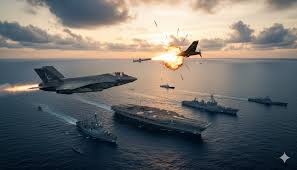
Tensions in the Arabian Sea and the Strait of Hormuz have escalated after the United States military shot down an Iranian drone near a US aircraft carrier, even as Washington and Tehran attempt to revive stalled nuclear negotiations.
According to US defence officials, an Iranian Shahed-139 drone was intercepted and destroyed by an F-35C fighter jet launched from the USS Abraham Lincoln. The US Central Command said the drone approached the carrier with what it described as “unclear and aggressive intent,” prompting defensive action to protect the vessel and its crew.
Iran acknowledged losing contact with one of its drones but avoided directly addressing the US claim that it was shot down. The incident has added to already high tensions in a region critical to global energy supplies.
In a separate incident in the Strait of Hormuz, Iranian Islamic Revolutionary Guard Corps (IRGC) speedboats allegedly harassed a US-flagged, US-crewed commercial tanker, M/V Stena Imperative. US military sources said the boats, supported by a Mohajer drone, approached the vessel at high speed and ordered it to stop for boarding.
The tanker reportedly increased speed and continued its journey, after which the US Navy destroyer USS McFaul intervened and escorted the vessel to safety. The situation later de-escalated, and the tanker is continuing its voyage without incident.
The developments come amid renewed diplomatic friction between Washington and Tehran. Iran has reportedly demanded that upcoming talks with the US be shifted from Turkey to Oman and limited strictly to nuclear issues. Iranian officials have also reiterated that the country’s defensive and military capabilities are non-negotiable.
US President Donald Trump confirmed that discussions with Iran are ongoing but declined to comment on the venue or agenda. He has previously warned that failure to reach an agreement could carry serious consequences.
Regional and international stakeholders have urged both sides to avoid further escalation, warning that continued confrontations could destabilise a key global shipping route and push the region closer to open conflict. Oil prices have already reacted to the rising tensions, reflecting market concerns over supply disruptions