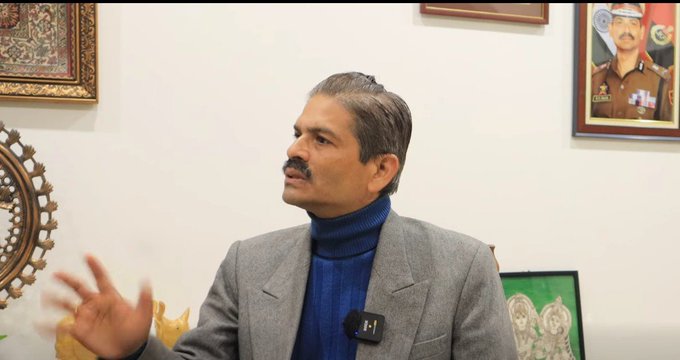
Srinagar, Jan 21: Retired Jammu and Kashmir Director General of Police Rashmi Ranjan Swain has said that during the peak years of militancy, the region effectively operated under two parallel authorities—India and Pakistan—while militants exerted significant influence over civil administration.
In an interview, Swain noted that the late separatist leader Syed Ali Geelani maintained contact with civil administration officials, who often complied with his directives. He added that the influence of militant-backed leadership was evident across multiple layers of governance.
Citing statistics from the prolonged conflict, Swain said that over the past 36 years, more than 47,000 people lost their lives due to militancy-related violence. Of these, around 22,000 militants were killed, nearly 12,000 civilians were killed by militants, and over 6,000 security personnel lost their lives.
He described the period between 1999 and 2000 as a turning point in counter-militancy operations, when political pressure began limiting the agencies’ ability to probe the broader militant network. Swain claimed that while security forces were allowed to neutralise militants, they were often restricted from investigating their finances, logistics, or ideological supporters.
Swain said that anti-militancy operations faced no political interference immediately after the elected government took office in 1996, but this changed later, weakening the agencies’ capacity to dismantle support networks behind militancy.
Highlighting the contribution of personnel from the Pir Panjal region, he said Rajouri and Poonch provided some of the finest members of the Special Operations Group, describing them as the cream of the force in confronting active militants on the ground.
On public perception, Swain observed that many in Kashmir doubt that Mirwaiz Umar Farooq was killed by militants, and alleged that false operations are sometimes publicised to shape narratives in the region.