Revenue Expenditure Pegged at ₹80,640 Cr; Capital Outlay at ₹33,127 Cr
Jammu, Feb 06:
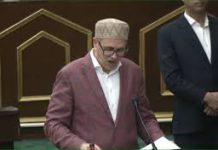
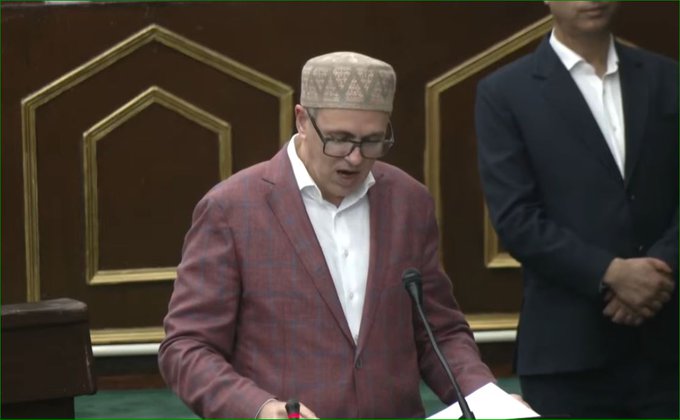
Chief Minister Omar Abdullah on Friday presented a ₹1,13,767 crore budget for the Union Territory of Jammu and Kashmir for the financial year 2026–27, marking a significant step towards fiscal consolidation and development-led governance.
While presenting the budget in the Jammu and Kashmir Legislative Assembly, the Chief Minister said that the total net budget estimates for 2026–27 stand at ₹1,13,767 crore. He clarified that this figure excludes provisions for ways and means advances as well as overdraft facilities.
Breaking up the allocation, Omar Abdullah informed the House that ₹80,640 crore has been earmarked for revenue expenditure, while ₹33,127 crore has been allocated towards capital expenditure, underlining the government’s focus on infrastructure creation and long-term asset development.
The Chief Minister further stated that under the Budget Estimates for 2026–27, the Union Territory is expected to receive ₹90,018 crore as revenue receipts and ₹23,749 crore as capital receipts.
Highlighting the efforts to strengthen the UT’s financial base, Omar Abdullah said that Jammu and Kashmir’s own revenue—comprising both tax and non-tax sources—is estimated at ₹31,800 crore for the coming fiscal year. He said this reflects improved revenue mobilisation and better fiscal management.
In addition to internal revenue generation, the Chief Minister said Jammu and Kashmir will receive substantial central support. According to the budget announcement, ₹42,752 crore is expected to flow as central assistance, while ₹13,400 crore will be received under various Centrally Sponsored Schemes (CSS).
The Chief Minister emphasised that the budget has been framed with a balanced approach, focusing on development, fiscal discipline, and welfare-oriented spending. He said the government aims to strengthen public services, improve infrastructure, and support economic growth while maintaining financial prudence.
The budget is expected to play a crucial role in addressing developmental priorities across sectors such as infrastructure, social welfare, public services, and economic revival, as the Union Territory continues its path towards sustainable growth.