
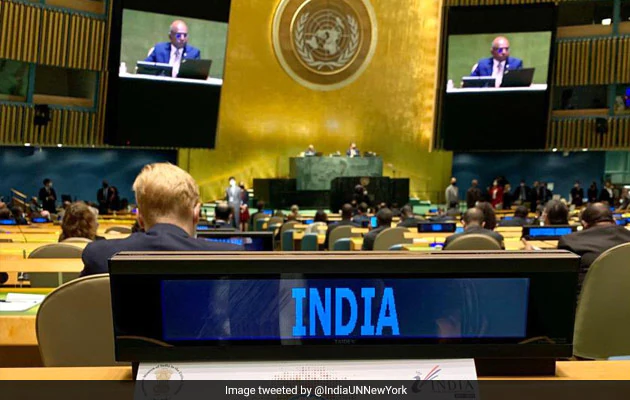
Geneva: India on Thursday voted against a Western-backed resolution at the United Nations Human Rights Council (UNHRC) that sought to express concern over the human rights situation arising out of protests in the Islamic Republic of Iran, signaling New Delhi’s continued opposition to what it calls selective and politically driven country-specific resolutions.
The resolution, moved by a group of Western nations, aimed at convening a special session of the UNHRC to discuss alleged human rights violations during protests in Iran. While the proposal secured majority support, it faced resistance from a section of countries that argued such moves undermine national sovereignty and politicise human rights mechanisms.
India joined China, Pakistan, Indonesia, Iraq, Cuba and Vietnam in voting against the resolution. In total, 25 countries voted in favour, 7 against, while 14 abstained, highlighting deep divisions within the 47-member council.
India has consistently maintained that human rights issues should be addressed through constructive dialogue and cooperation, rather than public censure or country-specific resolutions. New Delhi has also reiterated that internal matters of sovereign states should not be used as instruments of geopolitical pressure.
Countries supporting the resolution included several Western and European nations, while many Asian, African and Middle Eastern states either opposed or abstained, reflecting a broader debate within the UN system over the approach to human rights enforcement.
Iran has strongly criticised the resolution, calling it biased and politically motivated, and has accused Western powers of using human rights as a pretext to interfere in its internal affairs.
India’s vote is in line with its past stance at international forums, where it has often distanced itself from resolutions perceived as selective or intrusive, particularly when they target developing nations.
The outcome of the vote once again underscores the polarised nature of the UNHRC, where human rights concerns frequently intersect with global politics and strategic alignments, making consensus increasingly difficult.