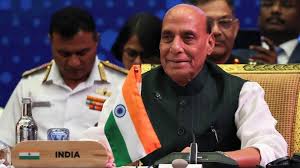
NEW DELHI: Defence Minister Rajnath Singh, speaking at the Sindhi Samaj Sammelan in the national capital, said that borders can change and suggested that “tomorrow Sindh may return to India again,” while referring to a remark once made by former Deputy Prime Minister L K Advani.
Sindh, historically known as the homeland of the Sindhi community and a key centre of the Indus Valley Civilisation, became part of Pakistan after the 1947 partition. Singh said that while Sindh is no longer part of India geographically, it remains deeply connected to Indian civilisation.
Quoting Advani, Singh said, “Today, the land of Sindh may not be part of India, but civilisationally it will always belong to India. And borders can change. Who knows, tomorrow Sindh may return to India again.”
He highlighted the region’s cultural and spiritual legacy, noting that many in Sindh considered the waters of the Indus River as sacred as the Aab-e-Zamzam in Mecca. “Sindhi Hindus, especially those of Advani’s generation, still haven’t accepted Sindh’s separation. The bond with the Indus is emotional and civilisational,” he said.
Singh also spoke about the Citizenship Amendment Act (CAA), calling it essential for protecting minority communities in neighbouring countries who have faced violence and persecution. He said earlier governments ignored the suffering of Hindu refugees, but Prime Minister Narendra Modi recognised their pain, prompting the introduction of the CAA.
He described the hardships faced by these communities — burned homes, targeted killings, forced conversions, and harassment — and criticised past administrations for denying them proper rights. “If anyone understood this suffering, it was our Prime Minister Narendra Modi. That is why the Citizenship Amendment Bill was brought,” he said.
The Citizenship (Amendment) Act, 2019 allows citizenship for migrants from Hindu, Sikh, Buddhist, Jain, Parsi, and Christian communities from Pakistan, Bangladesh, and Afghanistan who entered India before December 31, 2014, and were exempted from certain legal provisions. It was enacted on December 12, 2019, and implemented from January 10, 2020.