
By Gulistan News Bureau
The question of Jammu and Kashmir’s statehood has resurfaced prominently, with strong speculation that the Centre may consider a “controlled” or “limited” statehood model, resembling the Puducherry framework. While this move could bring back an elected government, it would fall short of restoring full state powers — raising alarms among mainstream political parties in the Union Territory.
What Is the Puducherry Model?
The Puducherry model offers a hybrid governance system — a Legislative Assembly and a Chief Minister with limited powers, while the Lieutenant Governor retains overriding control over crucial departments, especially law and order, public services, and administrative appointments. The territory functions under the AGMUT cadre, meaning officers are centrally appointed and transferred, without a distinct state service cadre.
In this model, the Centre remains the supreme authority on all matters of governance that it deems “sensitive” or “strategic.”
Legal Framework Enabling This Option
Legal experts suggest that the following provisions enable the Centre to adopt such a model for J&K:
Article 239 of the Constitution allows the President to administer Union Territories through LGs.
Article 246(4) empowers Parliament to legislate on any matter for Union Territories.
The Jammu and Kashmir Reorganisation Act, 2019 allows application of Union Territory-specific laws.
The Government of Union Territories Act, 1963, Sections 44(1), 44(3), and 25, empowers LGs to override elected councils on key issues.
Using these provisions, the Centre could revive political institutions in J&K without granting full-fledged state powers.
What Might This Statehood Look Like?
If adopted, this limited model may include:
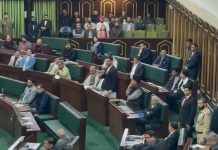
A Legislative Assembly with curtailed authority.
A Chief Minister with a council of ministers having advisory powers.
No authority over police, anti-corruption, or public services, which would remain under the Lieutenant Governor.
Officers from the AGMUT cadre, not a separate J&K cadre.
Essentially, this would allow elections and civilian governance — but under the strict supervision of the Centre.
Political Reactions: Firm Opposition Expected
If this arrangement is formalized, it is almost certain to face strong opposition from all major regional parties in Jammu and Kashmir:
National Conference (NC)
The NC, led by Dr. Farooq Abdullah and Omar Abdullah, has consistently demanded complete restoration of statehood and Article 370. The party sees any conditional or limited form of statehood as an “insult to the people’s democratic aspirations”.
“A state cannot be treated like a municipality. If Puducherry is your model, we reject it outright. Jammu and Kashmir was a full-fledged state with its own Constitution. What you offer is unacceptable,” Omar Abdullah has previously said in similar contexts.
People’s Democratic Party (PDP)
The PDP, headed by Mehbooba Mufti, is also likely to reject the Puducherry model. The party maintains that J&K was not just another state, and any downgraded governance structure would deepen the trust deficit.
“You can’t compensate for the August 5 betrayal by offering a diluted democracy. This isn’t restoration, it’s redesigning occupation in a civilian garb,” PDP leaders have repeatedly said.
Indian National Congress (INC)
The Congress has also demanded immediate and unconditional restoration of full statehood before assembly elections. Its leadership in J&K views any move to offer partial autonomy as “cosmetic and unconstitutional.”
“Democracy cannot be selective. J&K must be treated like every other Indian state. Anything less is unacceptable,” said senior JKPCC leaders in earlier statements.
Why the Centre May Still Choose This Path
Despite political opposition, the Centre may find the Puducherry model attractive due to:
Security concerns in the region.
The need for gradual political reintegration post-Article 370.
Maintaining bureaucratic and administrative control.
Offering limited democratic space ahead of elections.
This approach allows the government to project political normalization, without letting go of strategic control.
Conclusion
As Jammu and Kashmir waits for the announcement of election dates and future governance structure, the idea of limited statehood based on the Puducherry template is gaining quiet traction in policy circles. However, any such move will not go unchallenged.
The coming weeks may witness a renewed political battle — one that pits New Delhi’s cautious approach against Kashmir’s demand for full dignity, status, and democratic agency.