Srinagar: NewsDesk
Political temperatures in Srinagar have sharply risen following the decision of Mirwaiz Umar Farooq to remove references to the chairmanship of the All Parties Hurriyat Conference (APHC) and names of other organisations from his social media account on X. The move triggered a heated political exchange, with posters, statements, and counter-statements surfacing across the city.
Mirwaiz Umar Farooq clarified that the changes to his social media profile were made under pressure from authorities, who, according to him, warned that his account could be blocked if references to banned organisations were not removed. He maintained that the step did not reflect any ideological shift but was a compliance measure to avoid digital censorship.
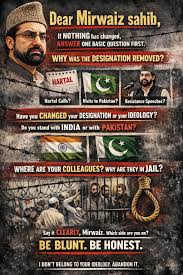
Despite the clarification, the development sparked strong reactions. Sheikh Imran of Srinagar, former Deputy Mayor, issued statements questioning the Mirwaiz’s position and intent. Posters critical of the Mirwaiz appeared in parts of the city and circulated widely on social media platforms, intensifying the political discourse.
The posters raised pointed questions regarding the removal of the APHC designation, alleged past political activities, and the continued detention of several separatist leaders. They also sought a clear articulation of political alignment, framing the issue as one of ideology rather than administrative compulsion.
Soon after, supporters of the Mirwaiz stepped forward in his defence, issuing statements asserting that he was being unfairly targeted. They argued that the removal of the designation was forced and should not be interpreted as abandonment of long-held political or religious positions. Supporters also criticised what they termed as “selective outrage” and warned against deepening divisions within Kashmiri society.
Political observers say the episode highlights the growing friction between expression, legal restrictions, and political symbolism in Kashmir’s evolving landscape. They note that social media has increasingly become a battleground where political legitimacy, ideology, and public perception are contested.
The poster campaign and counter-statements have added a new layer to the already sensitive political environment in the Valley. While no official action has been reported so far, the incident underscores how symbolic gestures—particularly in the digital space—can quickly escalate into broader political confrontations.
As reactions continue to pour in, the situation remains closely watched, with analysts cautioning against rhetoric that could further polarise public opinion in the region.