
Srinagar/Jammu: Saleem wani
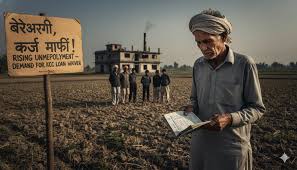
Economic concerns are mounting in Jammu and Kashmir as calls for waiver of Kisan Credit Card (KCC) loans grow louder amid rising unemployment and the absence of a comprehensive industrial policy in the Union Territory. With unemployment levels reportedly reaching nearly 32 percent, stakeholders, economists, and political representatives are expressing serious concern over the worsening financial condition of farmers and youth.
The Kisan Credit Card scheme was introduced to provide farmers with easy access to credit for agricultural and allied activities. However, in recent years, erratic weather conditions, fluctuating market prices, and increasing input costs have pushed many farmers into financial distress. Several farming communities have now demanded loan waivers, stating that they are struggling to repay agricultural credit due to declining income and limited government support mechanisms.
Alongside the agrarian crisis, unemploymenat continues to remain a major challenge in Jammu and Kashmir. Experts attribute the rising joblessness primarily to the absence of a robust industrial framework capable of generating large-scale employment opportunities. Despite repeated announcements and proposals, the region is yet to witness significant industrial expansion that could absorb the growing number of educated unemployed youth.
Economic analysts believe that industrial growth is crucial for diversifying the region’s economy, which heavily relies on agriculture, horticulture, and government employment. They stress that without a structured and investor-friendly industrial policy, the unemployment crisis may worsen, further increasing socio-economic pressures.
Political voices have also started highlighting the issue, urging the government to introduce a comprehensive relief package for farmers while simultaneously accelerating industrial development initiatives. Many stakeholders have suggested that targeted loan restructuring, interest subsidies, and skill development programs could help mitigate the crisis.
Meanwhile, youth organizations have called for immediate government intervention to create sustainable employment avenues, pointing out that prolonged unemployment could lead to social and economic instability. They have urged authorities to focus on entrepreneurship promotion, startup incentives, and infrastructure development to boost economic activity in the region.
As demands for economic reforms gain momentum, all eyes are now on the administration’s next move. Observers believe that timely policy decisions addressing both agricultural distress and unemployment could play a crucial role in stabilizing the region’s economy and providing relief to thousands of affected families across Jammu and Kashmir.