
Rajouri:
Former Minister and Vice President, Jammu and Kashmir BJP, Chowdhary Zulfkar Ali on Tuesday forcefully reiterated the long-standing and legitimate demands of the people of the twin border districts of Rajouri and Poonch for the establishment of a National Law University (NLU) at Rajouri and for the inclusion of Rajouri–Poonch under the Fifth Schedule of the Constitution of India.
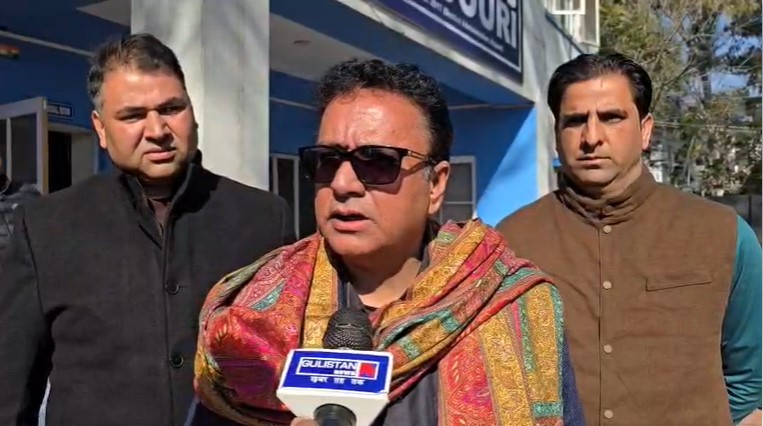
Addressing a press conference here, Chowdhary Zulfkar Ali was accompanied by Manzoor Ahmed Naik, State General Secretary, ST Morcha, and Mohd Arif Ranja, former Chairman, Municipal Council Rajouri, who unanimously endorsed the demands and expressed solidarity with the aspirations of the people of the region.
Speaking to the media, Chowdhary Zulfkar Ali highlighted the strategic significance of Rajouri–Poonch as a sensitive border belt adjoining the Line of Control (LoC), marked by difficult terrain, socio-economic challenges, and a long history of sacrifice for the unity and integrity of the nation. He said that despite these realities, the region continues to suffer from chronic institutional and educational neglect.
He asserted that the establishment of a National Law University at Rajouri is a justified and urgent requirement. “An NLU at Rajouri will provide access to world-class legal education for students of Rajouri–Poonch and adjoining areas, who are otherwise compelled to migrate to distant states. It will also generate employment, enhance legal awareness, promote constitutional literacy, and contribute significantly to the socio-economic development of this border region,” he said.
Chowdhary Zulfkar Ali further stated that such an institution would strengthen constitutional values, build a robust legal ecosystem, and reinforce national integration in one of the most strategically important regions of the country.
On the demand for inclusion of Rajouri–Poonch under the Fifth Schedule, he said the region has a substantial tribal population, particularly Gujjars and Bakerwals, who continue to face systemic social, economic, and infrastructural disadvantages. Despite constitutional safeguards, these communities remain vulnerable in terms of protection of land rights, cultural identity, and traditional livelihoods.
“Inclusion under the Fifth Schedule is not a political slogan but a constitutional necessity. It is essential for ensuring special protections, focused development, and the preservation of the unique socio-cultural identity of tribal communities. This long-pending measure will help correct historical injustices and ensure equitable and inclusive growth,” he emphasized.
He expressed concern that successive governments have failed to translate repeated assurances into concrete action, leading to growing disillusionment among youth and marginalized sections. “Committees, statements, and symbolic gestures have yielded no tangible results. The people of Rajouri–Poonch now demand clear timelines and decisive action,” he said.
Supporting the demand, Manzoor Ahmed Naik, State General Secretary, ST Morcha, stated that tribal communities across the region have consistently sought Fifth Schedule protection to safeguard their constitutional rights and livelihoods. He added that sustainable development is impossible without empowering tribal communities through robust constitutional mechanisms. “Despite the historic role of Gujjar-Bakerwal and Pahari tribes as the first line of defence in these border districts, their constitutional and developmental aspirations continue to remain unaddressed,” Naik added.
Mohd Arif Ranja, former Chairman, Municipal Council Rajouri, said that the establishment of a National Law University would transform Rajouri into a major educational hub, stimulate the local economy, and open new avenues of opportunity for the youth of the region.
Chowdhary Zulfkar Ali urged the Hon’ble Lieutenant Governor of Jammu and Kashmir, the Union Ministry of Law and Justice, and the Government of India to treat these demands with the seriousness they deserve and initiate immediate steps for their fulfillment. He said such measures would restore public confidence, promote inclusive development, and strengthen national unity in the border districts.
He also appealed to all elected representatives, civil society organizations, student bodies, and conscientious citizens to rise above political considerations and collectively support these demands in the larger interest of justice, equity, constitutional rights, and sustainable development.
“The people of Rajouri–Poonch will no longer accept neglect or second-class treatment. Establishment of a National Law University at Rajouri and inclusion under the Fifth Schedule are not favors—they are constitutional obligations and moral imperatives. The time for decisive action is now,” he concluded.