
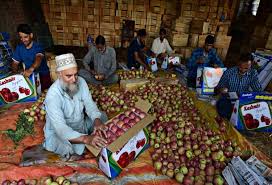
Srinagar Feb 08: Apple growers across India’s Himalayan belt, from Himachal Pradesh to Jammu and Kashmir, are expressing deep concern over the India–United States interim trade framework, fearing it could severely impact their livelihoods.
Farmers’ unions warn that increased imports of apples and other fruits from the United States, as part of the proposed trade arrangements, could financially devastate local growers. Harish Chauhan, convener of the Samyukt Kisan Manch — a collective of more than two dozen farmers’ organisations — described the development as a major blow to India’s apple economy.
Grower leaders are drawing parallels with India’s earlier free trade agreements with the European Union and New Zealand. Under these FTAs, import duties on apples and other fruits were reduced from around 50 per cent to as low as 20–25 per cent. Farmers argue that these reductions have already hurt domestic producers and that similar concessions under the India–US framework could worsen the situation.
Speaking to Gulistan News Network , Fayaz Ahmad Malik, Fruit Association President Sopore said apples are India’s most widely sold fruit, and any further reduction in import duties would make imported apples significantly cheaper. He warned that Indian farmers cannot compete with growers from countries like the United States or New Zealand, where production costs are lower and government support is higher. According to him, imported apples could become ₹15–20 per kilogram cheaper in Indian markets, undercutting domestic produce.
He explained that a box of American apples weighing 20 kilograms currently sells in Indian markets for around ₹2,500 to ₹2,700. Once landing and import costs are adjusted under reduced duties, these apples could be sold at nearly half the current price, pushing down the prices of premium Indian apples and damaging local markets.
India produces about 2.5 million metric tonnes of apples annually — roughly two per cent of global production. Jammu and Kashmir alone accounts for nearly 75 per cent of this output, generating more than ₹12,000 crore in annual revenue. Apple cultivation spans over 200,000 hectares, with Jammu and Kashmir, Himachal Pradesh and Uttarakhand being the main producing regions. Farmers’ unions estimate that recent trade agreements could trigger a 50 per cent drop in apple prices.
In Jammu and Kashmir, the apple sector directly or indirectly supports nearly 700,000 families. Many small growers say they are already under pressure due to climate change, erratic weather, floods, reduced snowfall, pest attacks and rising input costs.
Mohammad Abbas, a 35-year-old apple grower from Shopian who owns a 20-kanal orchard, said the trade deal has added to his worries. Still recovering from crop losses caused by last year’s floods, Abbas told ETV Bharat that cheaper imports could push farmers like him deeper into debt. He also highlighted health risks from the increasing use of pesticides to tackle new diseases linked to climate change.
On February 6, India and the United States announced a framework for an interim trade agreement. A joint statement said the framework reaffirms both countries’ commitment to broader bilateral trade agreement negotiations launched on February 13, 2025, by Prime Minister Narendra Modi and US President Donald Trump. The agreement aims to expand market access and strengthen supply chains.
Under the framework, India is expected to reduce or eliminate tariffs on a wide range of US industrial goods, food and agricultural products, including fresh and processed fruits. Union Commerce Minister Piyush Goyal has said the deal expands export opportunities without compromising sensitive domestic sectors such as dairy, and that farmers’ interests have been fully safeguarded.
However, these assurances have failed to calm growers in the Himalayan states. Farmers fear that once imported apples enter Indian markets in large volumes, their incomes could be hit by as much as 50 per cent.
Kashmiri apple growers have written to Prime Minister Narendra Modi, urging the government to impose a 100 per cent import duty on foreign apples to protect domestic farmers. Kashmir Valley Fruit Growers-cum-Dealers Union chairman Bashir Ahmad Basheer said recurring imports from countries like Iran, the US and others are creating constant pressure on local producers and called on the Centre to urgently address the concerns of apple growers.